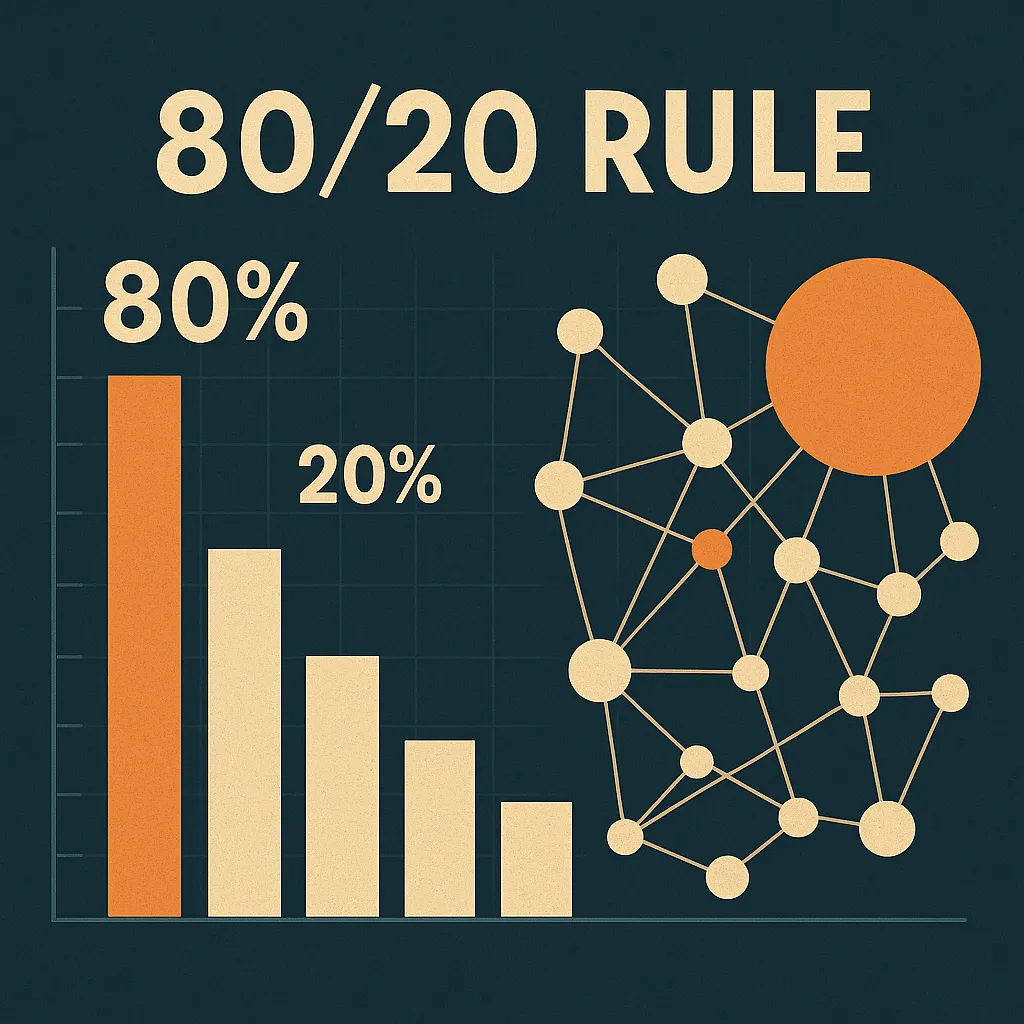
You've probably encountered the 80/20 rule countless times: 20% of customers generate 80% of revenue, 20% of websites receive 80% of traffic, 20% of social media users create 80% of content. Most people treat these as curious coincidences or useful rules of thumb for business optimization.
They're not…
These patterns aren't accidents, mere coincidences, or general heuristics; they are mathematical inevitabilities that emerge from the hidden network structures underlying our connected world. Today, we're going to pull back the curtain and show you exactly why inequality isn't a bug in complex systems; it is a feature.
More than a century ago, Vilfredo Pareto, an Italian economist who began his career as a civil and railway engineer, noticed this imbalance not in markets, but in his garden. He observed that a small number of pea pods produced the majority of his peas. Intrigued, Pareto turned his analytical eye toward society and discovered the same striking pattern in wealth: about 20% of Italians owned 80% of the land. What began as a simple observation in nature revealed a universal law of imbalance that shapes everything from economies to ecosystems.
The Ubiquity of Extreme Inequality
Before we dive into the mathematics, let's appreciate just how pervasive this pattern really is (and note, they aren't EXACT splits, but rough approximations).
Digital Ecosystems:
- 20% of websites receive 80% of internet traffic
- 20% of YouTube videos account for 80% of total views
- 20% of GitHub repositories get 80% of stars
- 20% of Twitter users generate 80% of tweets
Economic Systems:
- 20% of companies earn 80% of industry profits
- 20% of products generate 80% of sales revenue
- 20% of employees handle 80% of customer complaints
- 20% of cities contain 80% of economic activity
Academic and Cultural Production:
- 20% of scientific papers receive 80% of citations
- 20% of musicians earn 80% of streaming revenue
- 20% of authors sell 80% of books
- 20% of films earn 80% of box office revenue
The patterns exemplified above were not cherry-picked, but appear with startling consistency across virtually every domain where things can be connected, ranked, or measured. The question isn't whether the 80/20 rule exists; it's why it's so universal.
Enter the Pareto Distribution
The mathematical foundation of the 80/20 rule is the Pareto distribution, a probability distribution that captures "heavy-tailed" phenomena where a small number of extreme events dominate the total.
Formally, a Pareto distribution follows:
P(X > x) ∝ x(-α)
Where α (alpha) is the "Pareto exponent" that controls how extreme the inequality is. When α ≈ 1.16, you get the classic 80/20 split. Smaller values of α mean even more extreme concentration (95/5 rules), while larger values approach more egalitarian distributions.
This distribution is also known as a power law, and it's fundamentally different from the bell curves (normal distributions) that dominate intro-level statistics courses. While normal distributions have "thin tails" (extreme events are exponentially rare), power laws have "fat tails", where extreme events are merely polynomially rare.
This difference is profound: in a normal world, billionaires would be virtually impossible; in a power-law world, they're inevitable.
The Network Genesis of Power Laws
Here's where it gets interesting: networks naturally generate power laws through preferential attachment (Barabási & Albert, 1999)
Imagine you're building a social network from scratch. Each new user who joins must decide whom to follow. The rational choice? Follow the people who already have many followers, because you assume they might be creating valuable content. This creates a "rich get richer" dynamic where popular nodes become even more popular simply because they're already popular.
This mechanism, formalized by Albert-László Barabási and Réka Albert as the Barabási-Albert model, mathematically guarantees that the resulting network will have a power-law degree distribution. Let me show you exactly how this works.
Simulating Preferential Attachment
def simulate_preferential_attachment(n_nodes=10000, m_edges=3):
    """Simulate network growth with preferential attachment"""
    G = nx.complete_graph(m_edges)  # Start with small connected graph

    for new_node in range(m_edges, n_nodes):
        # Calculate attachment probabilities based on current degrees
        degrees = dict(G.degree())
        total_degree = sum(degrees.values())

        # Higher degree nodes have higher probability of new connections
        probabilities = {node: degree/total_degree
                        for node, degree in degrees.items()}

        # Select m_edges existing nodes to connect to,
        # favoring high-degree nodes
        targets = np.random.choice(
            list(G.nodes()), size=m_edges,
            replace=False, p=list(probabilities.values()))

        # Add new node and edges
        G.add_node(new_node)
        for target in targets:
            G.add_edge(new_node, target)

    return G
When we run this simulation with 10,000 nodes, something interesting happens: the degree distribution automatically arranges itself into a perfect power law with α ≈ 3.0, meaning roughly 20% of nodes accumulate about 80% of the connections.
Nobody programmed this inequality. It emerged naturally from local decisions about connection preferences.
The Mathematics Behind the Magic
The reason preferential attachment generates power laws isn't mysterious; it's a consequence of the underlying stochastic process. In continuous time, the probability that a node with degree k gains a new connection is proportional to k. This leads to a differential equation:
dk/dt = k × (rate of network growth)
The solution to this equation is exponential growth for individual node degrees, but when you account for the time at which each node joined the network, the resulting degree distribution follows a power law with exponent α = 3.
Variations on this basic model can produce different values of α:
- Fitness models: Nodes have intrinsic attractiveness beyond just their degree
- Aging models: Older nodes gradually lose their ability to attract new connections
- Copying models: New nodes copy the connections of existing nodes
Each variation tweaks the exponent but preserves the fundamental power-law structure.
Real-World Evidence: The Data Doesn't Lie
Theory is beautiful, but does it match reality? Let's examine some actual datasets:
Web Hyperlink Networks
The World Wide Web is perhaps the purest example of preferential attachment in action. When websites link to other sites, they overwhelmingly favor those that already attract many incoming links (e.g., Amazon, Wikipedia, Google). Early analyses of large web crawls revealed power-law in-degree distributions with α ≈ 2.1–2.5 (Albert, Jeong & Barabási, 1999), meaning a small fraction of pages capture most of the web's attention.
More recent large-scale analyses, however, have refined this picture. Eikmeier & Gleich (2017) re-examined the degree and spectral properties of real-world networks and found that while the Web still exhibits heavy-tailed link distributions consistent with power-law behavior, the exponents vary widely and pure power-law fits are often outperformed by truncated or log-normal alternatives. In other words, the rich-get-richer dynamic remains, but its statistical signature is more nuanced than early models suggested.
Translation: A relatively small share of websites receives a disproportionately large share of all incoming links, creating the attention hierarchy we see online.
Social Media Networks
Twitter's follower network exhibits clear power-law structure with α ≈ 2.3. This means:
- ~1% of users have 10,000+ followers
- ~0.1% of users have 100,000+ followers
- ~0.01% of users have 1,000,000+ followers
The same pattern holds for Instagram, TikTok, and essentially every social platform ever studied.
Academic Citation Networks
Scientific papers follow preferential attachment when citing previous work, for instance, highly cited papers are more likely to be cited again. The result? A citation distribution with α ≈ 2.5-3.0, where approximately 20% of papers receive 80% of citations.
It's a sobering reminder that popularity in science, like online influence, can be self-reinforcing. Once a paper becomes well known, it tends to attract ever more attention, regardless of its intrinsic merit. Something to think about the next time we assume that higher citation counts necessarily mean "better" science.
This creates what researchers call "Matthew effects", describing the accumulative advantage where early success breeds more success, often independent of actual quality.
The Fragility Hidden in Robustness
Networks that follow power laws have a fascinating dual nature: they're simultaneously robust and fragile.
Robust because random failures don't matter. If you randomly remove 50% of nodes from a power-law network, the remaining structure usually stays connected. This makes sense since most nodes have low degree, so removing them barely affects overall connectivity.
Fragile because targeted attacks are devastating. Remove just the top 10% of hubs (highest-degree nodes), and the entire network often fragments into isolated clusters.
Demonstration: Network Attack Simulation
def simulate_network_attacks(network, attack_fraction=0.2):
    """Compare targeted vs random node removal"""
    # Targeted attack: remove highest-degree nodes first
    degrees = dict(network.degree())
    hubs = sorted(degrees.keys(),
                  key=lambda x: degrees[x], reverse=True)

    targeted_resilience = []
    random_resilience = []

    for i in range(int(len(network) * attack_fraction)):
        # Remove hub
        network_targeted = network.copy()
        network_targeted.remove_nodes_from(hubs[:i+1])
        largest_component = max(
            nx.connected_components(network_targeted), key=len)
        targeted_resilience.append(len(largest_component))

        # Remove random nodes
        network_random = network.copy()
        random_nodes = random.sample(
            list(network.nodes()), i+1)
        network_random.remove_nodes_from(random_nodes)
        largest_component = max(
            nx.connected_components(network_random), key=len)
        random_resilience.append(len(largest_component))

    return targeted_resilience, random_resilience
The results are striking: removing 20% of hubs often shrinks the largest connected component by 80% or more, while removing 20% of random nodes barely affects network connectivity.
This dual nature has profound implications:
- Infrastructure networks (power grids, internet) are vulnerable to targeted attacks on major hubs
- Social movements can be disrupted by targeting key influencers
- Economic systems can collapse when major players fail (2008 financial crisis, anyone?)
Why This Matters: Implications for Everything
Understanding the network origins of the 80/20 rule isn't just an academic fascination; it fundamentally changes how we should think about inequality and intervention.
Sociological Implications
If inequality emerges naturally from network growth, it suggests that perfectly egalitarian societies may be mathematically impossible in domains where connections matter. This doesn't mean we should accept all forms of inequality, but it does mean we need to be realistic about what policies can achieve.
The key insight: inequality isn't necessarily evidence of unfairness; it could be evidence of network effects.
Technological Implications
Platform designers who understand preferential attachment can either amplify or dampen these effects:
Amplifying inequality (current default):
- Algorithmic feeds that prioritize already-popular content
- "Trending" sections that boost items with high engagement
- Search rankings that favor established players
Dampening inequality (requires intentional design):
- Randomized recommendation algorithms
- Explicit promotion of new or smaller creators
- Time-based decay functions that limit accumulative advantage
The choice isn't neutral, but architectural politics embedded in code.
Economic Implications
For businesses, recognizing power-law dynamics changes strategy fundamentals:
- Don't aim for the average customer: optimize for the power-law tail of high-value users
- Network effects aren't linear: early market share advantages compound exponentially
- Winner-takes-all dynamics are the default: plan accordingly or actively subvert them
The Philosophical Puzzle
This brings us to a deeper question: in a connected world where network effects are increasingly dominant, should we fight the 80/20 rule or embrace it?
Arguments for fighting it:
- Extreme inequality can be socially destabilizing
- Concentration of power in a few nodes creates systemic fragility
- Many domains benefit from diversity rather than optimization
Arguments for embracing it:
- Network effects often create enormous total value even if unequally distributed
- Attempting to fight mathematical inevitabilities may be futile
- Power laws can efficiently allocate attention to the highest-quality offerings
Perhaps the answer isn't binary. Instead of asking whether we should accept inequality, we might ask: In which domains do we want network effects to operate freely, and in which do we want to actively counteract them?
Conclusion: Connection as Destiny
The 80/20 rule isn't just an empirical regularity, but a mathematical fingerprint of networked growth. Every time we create systems where new connections preferentially attach to already well-connected nodes, we're creating the conditions for power-law distributions and extreme inequality.
This means that in our increasingly connected world, your position in the network increasingly determines your outcomes. Whether you're a creator seeking an audience, a company building market share, or a researcher pursuing citations, success isn't just about quality, but connection strategy.
The networks we build shape the inequalities we get. The algorithms we deploy determine whether we amplify or dampen power-law effects. The connections we facilitate create the hierarchies we inhabit.
In a connected world, every node competes for links, and the connection itself becomes destiny.
Technical Appendix
For readers who want to dive deeper into the mathematics and code:
Complete Analysis Notebook
💻 Want to experiment with the network models behind this post? The full Python notebook is available by request: I prefer sharing it personally so I can point you to the right dependencies and context.
Key Libraries Used
- NetworkX: Network analysis and generation
- NumPy/SciPy: Statistical analysis and power-law fitting
- Matplotlib/Seaborn: Data visualization
- pandas: Data manipulation
Datasets and Further Reading
- Stanford Network Analysis Project (SNAP): Real-world network datasets
- "Linked" by Albert-László Barabási: Accessible introduction to network science
- "The Black Swan" by Nassim Taleb: Understanding fat-tail distributions
- "Scale" by Geoffrey West: Power laws in biological and social systems